Fact-Check Your Information (FYI): A Design Probe to Understand How People Actually Fact-Check Data-Driven Articles
Abstract
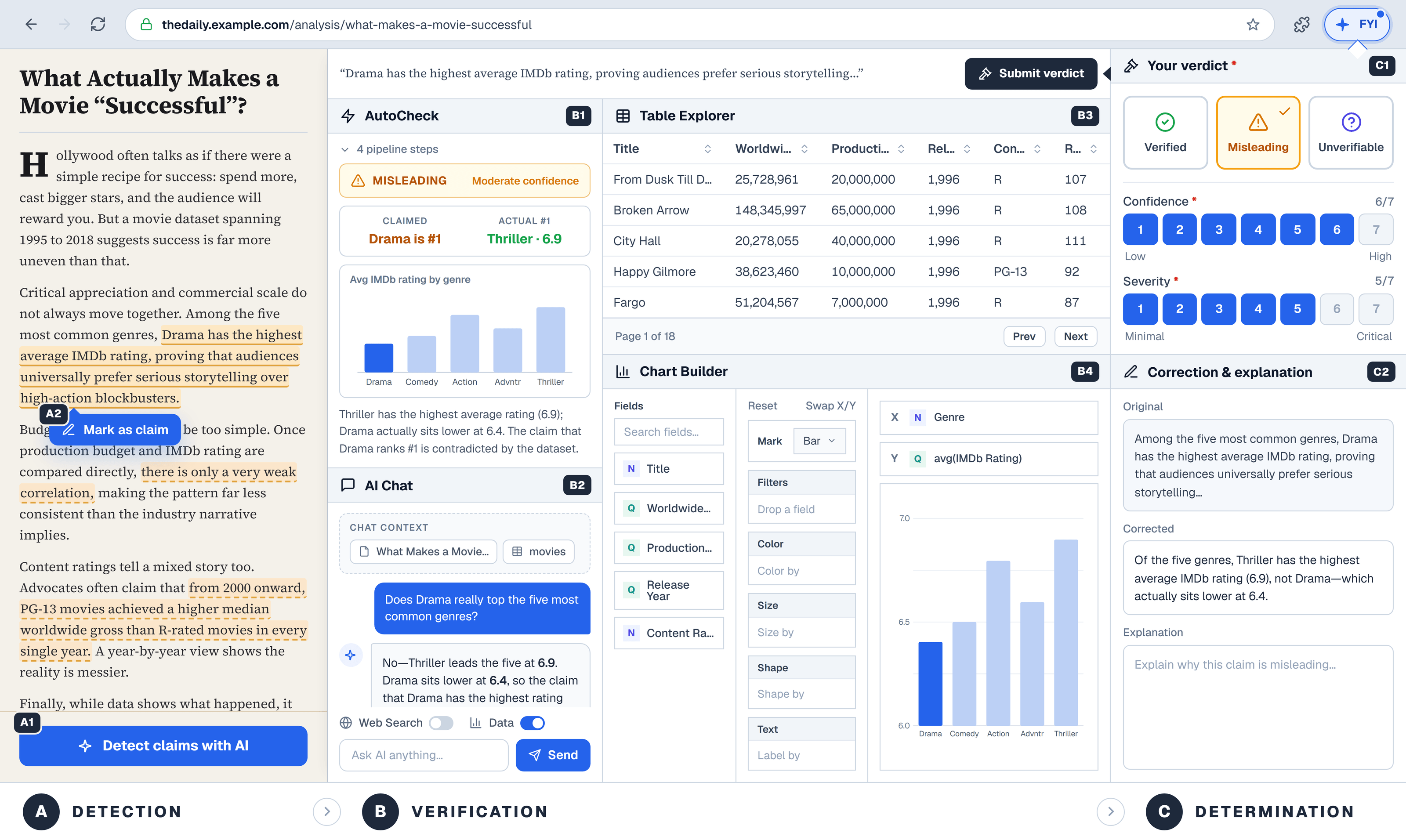
Data-driven journalism and policy reports frequently rely on statements grounded in statistical evidence, referred to as data claims. Verifying such a claim requires connecting it to the underlying structured dataset. However, existing systems typically isolate automated fact-checking from manual data exploration, leaving it unclear how readers coordinate AI assistance with manual inspection of the evidence in practice.
We present FYI, a browser extension that embeds fact-checking in the reading environment, and use it as a design probe to study how people detect, verify, and determine the validity of data claims against the underlying dataset. FYI provides four complementary tools spanning the spectrum from full automation to manual data exploration. In an exploratory study (N=22), participants used FYI to fact-check claims in a data-driven article.
We find that participants adopted three distinct workflow archetypes (AI-first with manual confirmation, manual-first with AI supplement, and parallel co-review), with visualization serving as the primary mechanism for auditing AI conclusions. Trust in AI shifted dynamically, growing when multiple tools converged and eroding when AI outputs were inconsistent.
These findings suggest that fact-checking systems should treat AI as a starting point that human verification complements rather than a definitive authority, elevate visualization as a core verification capability, and support flexible, user-driven workflows. We release FYI as open-source software for further research at github.com/DataVisards/FYI.
Resources
Paper
To appear at IEEE VIS 2026
Pre-print
GitHub
Web application
Browser extension
To be available on the Chrome Web Store